Source of truth for the encrypted vault. Both the Go core and the Swift core MUST implement this byte-for-byte. Interop CI cross-decrypts and runs negative tests against testvectors.json.
Load-bearing decision: envelope encryption
A random 256-bit Data Encryption Key (DEK) encrypts the account payload. The DEK is wrapped independently by each unlock method; every wrap is stored in the envelope. This lets one vault carry a Secure-Enclave (Mac app) wrap and a passphrase wrap side by side — the CLI opens the passphrase wrap, the app opens either — and lets CloudKit round-trip without breaking the single shared format. Adding/removing an unlock method re-wraps the DEK; it does NOT re-encrypt the payload.
File
UTF-8 JSON, no BOM. Top-level object:
{
  "version": 1,
  "aead": "xchacha20poly1305",
  "wraps": [ <wrap>, ... ],     // >= 1; order not significant
  "payload": { "nonce": "<b64>", "ct": "<b64>" }
}wrapsMUST be non-empty on disk. An implementation may hold a zero-wrap envelope in memory while assembling one (SwiftEnvelope.createUnwrapped), but MUST attach at least one wrap before persisting; a zero-wrap file is permanently unopenable.aeadis alwaysxchacha20poly1305. Nonces are 24 bytes, fresh per encryption (192-bit space removes nonce-reuse risk).ct= ciphertext with the 16-byte Poly1305 tag appended (libsodium/chacha20poly1305combined-mode layout).payload.ct=XChaCha20-Poly1305(seal(canonical_json(accounts), key=DEK, nonce=payload.nonce)).
Passphrase wrap
{
  "type": "passphrase",
  "kdf": "argon2id",
  "params": { "v": 1, "m": 131072, "t": 3, "p": 4 },   // m in KiB = 128 MiB
  "salt":  "<16 bytes, b64>",
  "nonce": "<24 bytes, b64>",
  "ct":    "<seal(DEK), b64>"
}
wrapKey = argon2id(passphrase_utf8, salt, t, m, p, keyLen=32). ct = XChaCha20-Poly1305(seal(DEK, wrapKey, nonce)). params.v is the param-version; raising m/t/p later bumps v and the vault re-seals this wrap on next successful unlock (payload untouched).
Secure Enclave wrap (Mac app only)
{
  "type": "secure-enclave",
  "se_key": "<SecureEnclave.P256 key dataRepresentation, b64>",
  "nonce": "<24 bytes, b64>",
  "ct":    "<seal(DEK), b64>"
}
A non-extractable SE P-256 key, created with .privateKeyUsage and, when the user enables “Require Touch ID”, .biometryCurrentSet. wrapKey = HKDF-SHA256(ECDH(se_priv, se_pub)) -> 32 bytes (self key-agreement; salt tessera.se.salt.v1, info tessera.se.dek.v1). ct = XChaCha20-Poly1305(seal(DEK, wrapKey, nonce)). The plaintext DEK never rests on disk; the biometric flag is an OS access-control attribute and does not change the wire format. This is the Mac app’s default daily-unlock wrap (no argon2); the passphrase wrap is the cross-platform/export path and the SE-unavailable fallback.
Base64
All b64 fields are base64 standard alphabet (RFC 4648 §4, +/), WITH = padding. NOT base64url. Decoders MUST reject base64url and missing padding.
Canonical JSON (the sealed-before-encryption payload)
payload.ct decrypts to canonical JSON of the account array. “Canonical” is defined as MUST rules so both impls produce identical bytes (cross-decrypt depends on it):
- Object keys sorted ascending by UTF-8 byte order (not locale, not language Dictionary order).
- No insignificant whitespace. No newlines. UTF-8, no BOM.
- Strings: Go
encoding/jsonstring escaping with HTML-escaping OFF (json.Encoder.SetEscapeHTML(false)), which is exactly:- The two-character escapes
\",\\,\n,\r,\t. A control char< 0x20with no two-character form is\u00XXwith lowercase hex (e.g. U+0001 ->\u0001). /,<,>,&are NOT escaped (that is what HTML-escaping off means).- No non-ASCII escaping: emit raw UTF-8. The ONE exception is the line separators U+2028 and U+2029, which Go always escapes as
\u2028/\u2029regardless of the HTML-escaping setting; both cores MUST escape them too.canonical_edge.jsonpins all of the above.
- The two-character escapes
- Numbers: integers only, base-10, no leading zeros, no
+, no exponent, no decimal point. Counters fitint64. - Secrets are RAW key bytes, base64-standard with padding (see above). Google-migration secrets arrive as raw bytes; Steam secrets are base64-decoded to raw bytes; otpauth secrets are base32-decoded to raw bytes. The payload normalizes ALL to raw-bytes-then-base64.
- Parsers MUST reject duplicate keys.
This canonical form is the SEALED-BEFORE-ENCRYPTION bytes. It is NOT a stable on-disk artifact: AEAD output differs every write (fresh nonce), so two encrypted files of the same accounts are NOT equal. Interop CI diffs the DECRYPTED canonical bytes, never the encrypted file.
Account object
{
  "account": "john@example.com",
  "algorithm": "SHA1",            // SHA1 | SHA256 | SHA512
  "counter": 0,                    // HOTP only; 0 for totp/steam
  "created_at": 0,                 // unix seconds
  "digits": 6,
  "folder": "",
  "handle": "ac",              // OPTIONAL; see Handles
  "id": "uuid-v4",
  "issuer": "ACME",
  "period": 30,
  "pinned": false,
  "secret": "<raw bytes, b64-standard>",
  "tags": [],
  "type": "totp",                  // totp | hotp | steam
  "updated_at": 0
}
(Keys shown sorted, as they MUST be serialized.)
Forward compatibility. Readers MUST ignore fields they do not recognize in a decrypted account object rather than rejecting the payload. The payload is AEAD-authenticated, so tolerating unknown fields after a successful decrypt is safe, and it lets an older implementation open a vault written by a newer one that added a field. Writers MUST NOT emit any field not defined by this spec; canonical encoding remains exactly the spec fields above (an unknown field read from disk is dropped, not re-serialized). Duplicate-key rejection (rule 6) and envelope/header strictness are unaffected.
Handles
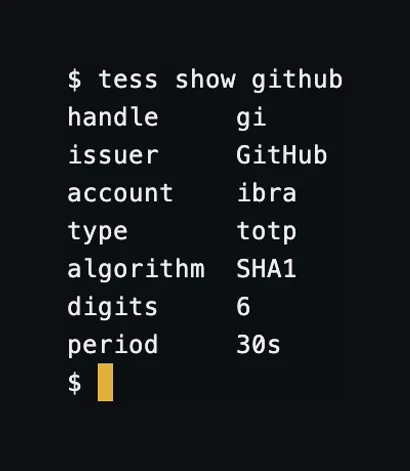
A handle is a short, unique, user-typeable identifier for an account (e.g. gi, go2, aw3), shown alongside the account in both the CLI and the app and accepted wherever an account is looked up. It disambiguates accounts that share (or lack) an issuer.
handleis an OPTIONAL string account field. When present it MUST match^[a-z][a-z0-9]{0,11}$(lowercase, leading letter, 1–12 chars) and MUST be unique across all accounts in the vault.- It sorts between
folderandidin the canonical key order (UTF-8 byte order), as shown above.
Compatibility. Vaults written before handles existed have no handle on their accounts. Handles are NOT required on disk: an account MAY omit the field. Implementations MUST auto-assign a handle to every account that lacks one at unlock (see Handle assignment). Assignment happens in memory at unlock; the implementation then persists the newly assigned handles immediately on unlock, in a single atomic write (re-wrap-free: the payload is re-sealed with the assigned handles; wraps untouched). A read-only open that cannot write (e.g. --vault pointing at a read-only file, or an export-only path) keeps the assigned handles in memory only and does not persist them; the same deterministic algorithm reproduces identical handles on the next writable unlock.
User-editable. Handles are user-editable. An edited handle MUST satisfy the charset and the uniqueness rules above; the interface rejects an edit that violates either. Auto-assignment NEVER overwrites a handle that is already present (whether original or user-edited).
Handle assignment
Deterministic; both cores MUST produce identical handles for identical input.
Assignment order. When multiple accounts lack a handle, assign them in ascending created_at, then ascending id (lexicographic). This makes migration order-independent of vault storage order.
For each account needing a handle:
- Base source string. Normalize the
issuer: lowercase, keep only[a-z0-9 ](drop everything else), collapse runs of whitespace to a single space, trim. If the result is empty, normalize the local part ofaccount(the substring before the first@) the same way. If that is also empty, the base is the literalacctused verbatim (skip step 2 — do NOT re-derive it to first-two-chars; the base isacct, notac), and proceed to step 3. - Base. Split the base source on spaces into words. A single word yields its first two characters (or its one character, if the word is a single char). Two or more words yield the first character of each of the first two words. If the resulting base begins with a digit, prefix it with
x. - Uniqueness. If the bare base is not already taken by any existing handle in the vault, assign it. Otherwise assign
base+N, whereNis the smallest integer ≥ 2 such thatbase+Nis not taken by ANY existing handle (including original and user-edited ones). Each newly assigned handle immediately counts as taken for the accounts assigned after it. Existing handles are NEVER renumbered when accounts are added or removed.
Examples: issuer ACME → ac; issuer GitHub (single word, first two chars) → gi; issuer Google Cloud → gc; issuer 1Password (base 1p, digit-leading) → x1p; empty issuer, account alice@example.com → local part alice → al; empty issuer and empty account → acct. A second GitHub when gi is taken → gi2; a third → gi3; if a user already edited some handle to gi2, the auto-assigned third GitHub skips to gi3.
Account resolution (CLI/app lookup)
When the user references an account by a text query, both the CLI and the app resolve it by this precedence:
- Exact handle match (handles are always lowercase; compare against the lowercased query).
- Exact
issueroraccountmatch, case-insensitive. - Unique substring match against
handle,issuer, oraccount, case-insensitive.
The first stage that yields exactly one account resolves. If a stage yields more than one match, the interface MUST present the matching accounts (each shown with its handle) so the user can pick, rather than failing with a bare “not found” / “ambiguous” error. Only when no stage matches anything is it an unresolved-account error.
Editing handles. Editing a handle is a first-class action, not a buried setting. The CLI MUST provide a dedicated tess alias <account> <new-handle> command (in addition to any --handle flag on the modify path), and the app MUST expose the handle as an editable field on the account. Both surfaces apply the same charset and uniqueness validation as auto-assignment. Changing a handle frees the old value, which then becomes available to future auto-assignment.
Vault path
Canonical shared path: $XDG_DATA_HOME/tessera/vault.json (default ~/.local/share/tessera/vault.json), overridable by --vault / $TESSERA_VAULT. The Mac app defaults to this SAME path (not its sandbox container) so the CLI and app share one vault. Under the App Store sandbox the Mac app obtains a one-time user-granted security-scoped bookmark to ~/.local/share/tessera/ and persists it; it does not relocate the vault. This is the correct sandbox pattern.
Failure modes (negative tests, MUST reject)
- Tampered ciphertext or tag (AEAD auth failure).
- Wrong passphrase (argon2id -> wrong wrapKey -> DEK unseal fails).
- Truncated / malformed envelope, bad base64, base64url input, missing padding.
- Duplicate JSON keys in the decrypted payload.
- Unknown
versionoraead.
Handle test vectors
testvectors.json and canonical_edge.json MUST cover handles so both cores stay byte-identical. The Go implementer regenerates these via go/internal/vectorgen; the coverage below is the contract.
- Accounts serialized WITH a
handlefield (canonical output includes it in sorted position betweenfolderandid). - Multi-word issuer → base from first char of each of the first two words (e.g.
Google Cloud→gc). - Digit-leading issuer →
x-prefixed base (e.g.1Password→x1p). - Empty issuer with an email account → base from the local part (e.g. issuer
"", accountalice@example.com→al). - Collision chain producing
base,base2,base3from three accounts with the same base. - A user-edited handle occupying
base2so the next auto-assignment skips tobase3(proves auto-assign avoids taken handles and never renumbers).