Two-factor codes you own.
A native Mac app and the tess command line on one documented vault format. Offline, with no account.

$brew install ibrahemid/tap/tessmacOS 14 or later · Apache-2.0 · tess 1.1.0 for macOS and Linux · all install options
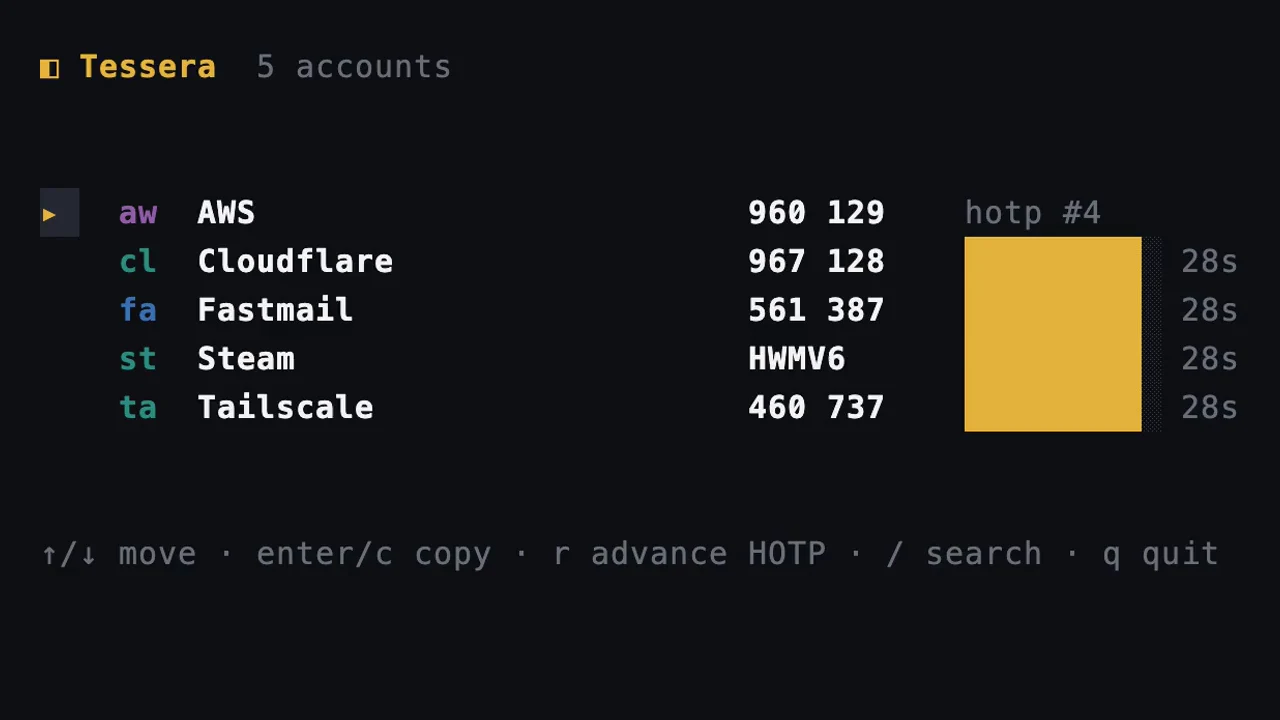
Recorded from the real CLI against a throwaway vault.
Install
App version 1.0.2.
The app and the CLI are separate downloads. They share one vault once you open the CLI's file in the app, or set a recovery passphrase in the app's settings.
- Homebrew
-
$brew trust ibrahemid/tapHomebrew 6 loads a third-party tap only after it is trusted. Formula: ibrahemid/homebrew-tap.$brew install ibrahemid/tap/tess - Script
- Downloads the release tarball for the current OS and CPU, verifies its sha256 against checksums.txt, and puts tess in /usr/local/bin or ~/.local/bin. Read install.sh first.
$curl -fsSL https://raw.githubusercontent.com/ibrahemid/tessera/main/install.sh | sh - Tarballs
-
- macOS, Apple silicon 75df08b715dc31a326d25061a64171423bce245cf6f5943753577470a0275568
- macOS, Intel 84cd31b461cc868cdb219b3da47c7885fff70f9a6b501a69258d1b5aea5399f7
- Linux, arm64 baf83665ca822a8f75882cc9e08178593d8ca65bbf8c6deb3d4158fbb4264346
- Linux, x86_64 94144967eddcc5635ce2f1087ea51644fc7195b8482a7c28c12622804b933387
- From source
- Go 1.26.2 or later.
$go install github.com/ibrahemid/tessera/go/cmd/tess@latest
Then tess vault init, tess add, tess watch. Vault path: ~/.local/share/tessera/vault.json. The full reference is on /cli.
A native Mac app on the same vault.
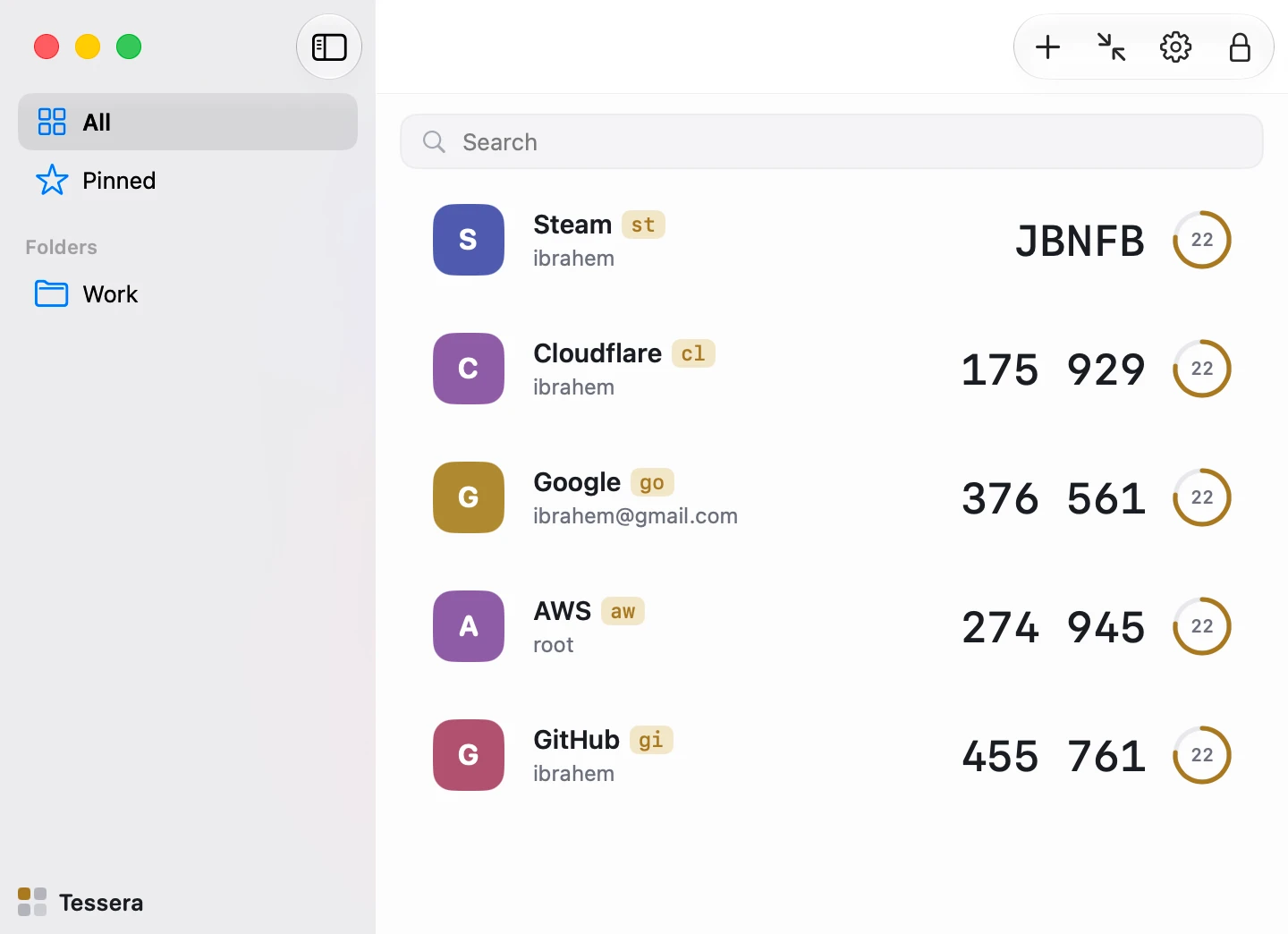
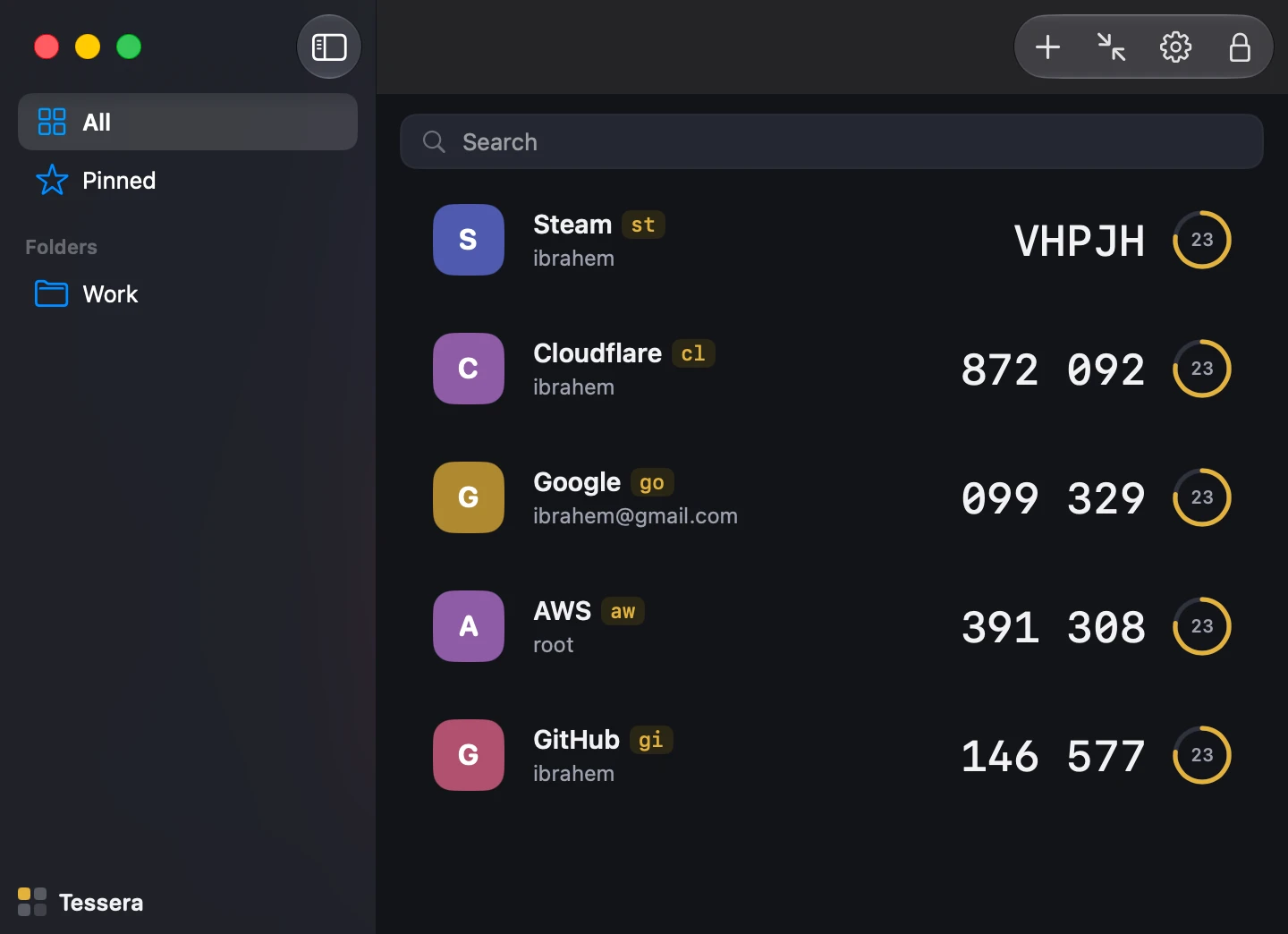
Live codes with countdown rings, one-click copy, on-screen QR scanning and Touch ID unlock. It opens a vault the CLI created, and the CLI keeps working on the same file.
- TOTP, HOTP and Steam Guard.
- Imports otpauth links, Google Authenticator exports, and files from Aegis, 2FAS, Raivo, andOTP, FreeOTP+, Stratum, Bitwarden, Proton Authenticator, Ente Auth, Apple Passwords and 1Password.
- Folders, pinning, and a short handle per account that both surfaces share.
- Copied codes are marked concealed for clipboard managers, and the window is excluded from screen capture.
One vault, two implementations.
The Go CLI and the Swift app are separate codebases that must open each other's files byte for byte. The contract is written down, pinned to test vectors, and checked in CI on every push.
Canonical JSON
Before encryption the account list is serialized one way only: keys sorted by UTF-8 byte order, Go's string escaping with HTML escaping off, no whitespace, integers only. Both cores produce the same bytes, so cross-decrypt can diff them.
Shared vector suite
spec/testvectors.json pins envelopes, wraps, codes and the edge cases. The Go tests, the swiftc verifier and the XCTest suite all read the same file; a change to one core that the other cannot open fails the vectors.
CI cross-decrypt
Every push runs the Go suite, compiles TesseraCore with swiftc against the vectors, and runs swift test, which decrypts a Go-written vault with real argon2id.
The whole contract is on /vault-format.
Security you can read.
Each line links to the file that does it.
- argon2id
- A passphrase wraps the vault key through argon2id at 128 MiB, t=3, p=4 with a 16-byte salt. Go uses golang.org/x/crypto; Swift uses the vendored PHC reference implementation, checked against the same known answer. go/internal/vault/vault.go · swift/Sources/CArgon2
- XChaCha20-Poly1305
- A random 256-bit key encrypts the account payload with a fresh 24-byte nonce on every write. Each unlock method wraps that key separately, so adding or removing a method never re-encrypts the payload. spec/vault-format.md · swift/Sources/TesseraCore/XChaCha.swift
- Secure Enclave wrap
- The app wraps the key with a non-extractable Secure Enclave P-256 key (HKDF-SHA256 over a self key agreement). Require Touch ID adds the biometry access control. Set a recovery passphrase in Settings and the same file gains an argon2id wrap the CLI can open. swift/App/Sources/SecureEnclaveWrap.swift
- No network entitlement
- The app's entitlements are App Sandbox, user-selected files and app-scoped bookmarks. There is no network entitlement, so the app cannot open a connection. The CLI makes no network connections: it imports neither net nor net/http. swift/App/Resources/Tessera.entitlements · go/go.mod
- Sandboxed
- The Mac app runs in the App Sandbox and ships through the Mac App Store, where its privacy label reads Data Not Collected. The vault it shares with the CLI is reached through a bookmark you grant once. App Store listing · PrivacyInfo.xcprivacy
More on /security, including what to do if you find something.